The network stops where the road stops
Most facilities outside the trunk corridors are reached by one route, on one surface, in one condition. When that route degrades, the whole supply line degrades with it.

Autonomous aerial logistics built to move critical cargo beyond the limits of traditional infrastructure.
Electric rotors for vertical precision takeoff and landing anywhere without runways. A combustion engine for long-range cruising. Refuel and relaunch in under 10 minutes. Operated in Kenya under partnership with The Good Drone Company.
0 kg
Maximum Payload
Temperature-monitored cargo capacity
0 km
Maximum Range
Long-haul regional flight radius
0 km/h
Cruise Speed
Efficient transit velocity
0 km/h
Top Speed
Dash & emergency burst capability
0 m
Max Altitude
Barometric service ceiling
The problem
Kenya has the goods, the roads and the operators. What's missing is a way to move small, urgent, high-value consignments to places where road freight has never been reliable or economic — and to do it to a schedule.
Most facilities outside the trunk corridors are reached by one route, on one surface, in one condition. When that route degrades, the whole supply line degrades with it.
A vehicle and a driver cost the same whether they carry 2 kg or 2 tonnes. So the small, urgent, high-value load waits for a full truck — or never moves at all.
Operators do not plan around averages, they plan around worst cases. Unreliable transit forces buffer stock, duplicated inventory and cancelled procedures.
Same cargo, same route
A 120 km county referral run, carried two ways.
Road transit is set by surface, traffic and consolidation waits. A flight is set by airspeed. For a blood unit, a lab sample or an isotope with a 110-minute half-life, that difference decides whether the cargo is still useful on arrival.
By road
4.5hrs
Typical door-to-door on a 120 km county run, including consolidation and route conditions. Operator estimate.
By Thatcher X
1.1hrs
Direct routing at 115 km/h cruise, launched on demand. Indicative for a 120 km county run.
No amount of road investment fixes a consignment that is too small to justify a truck and too urgent to wait for one.
Our four key pillars
Cargo flights are the most visible part of what we do. They rest on the same four pillars we use with regulators, county partners and funders.
01 · HCDI
Health is our focus first: time-critical delivery of blood, vaccines, anti-venom and cold-chain diagnostics between facilities, where an hour of downtime costs far more than the flight.
Contracted02 · 3PL
Middle-mile B2B and e-commerce parcel logistics, cross-subsidising the health hubs.
LOI signed03 · Works
Local airframe assembly, payload-pod production and fleet MRO at the Konza Technopolis Special Economic Zone.
In development04 · ASP
BVLOS corridor design, safety-management playbooks and KCAA ROC-readiness frameworks for other operators and governments.
Early-stageHover or tap a pillar to read its detail
Operational Capabilities
Select any use case to explore flight specifications, mission profiles, and Kenya regional corridors.
The category
Autonomous delivery in Africa has been built almost entirely around small, standardised, urgent parcels. That solves one problem very well. It leaves the heavier middle mile unserved.
10 – 25 kg
Heavy middle mile
Full consignments, inter-facility resupply, commercial freight. This is the band Thatcher X is built for, and the one with the fewest operators serving it at scale in the region today.
Slice size reflects the payload span each class covers. At 25 kg, a single sortie carries a materially larger consignment than today's small-payload delivery platforms, which operate at 1.8 kg and 3.6 kg per flight — and it does so without a launch catapult or a recovery net.
The network
Select a phase to see how the network grows from a single county hub to national coverage. Phases 3 and 4 are modelled projections, not committed builds.
Ten Level 3/4 facilities around the Siaya county referral hospital hub — three round trips per facility per week, 3,120 flights in year one, all routes physically surveyed — alongside the Konza flight-test site and a Murang'a facility. Launching Q4 2026.
3 hubs · 2 routes shown
Traction
The barriers that stop most drone ventures are regulatory, technical and institutional. Each one is cleared and evidenced.
Technology
Sole Kenyan operating rights for the 25 kg hybrid VTOL platform.
ExecutedInfrastructure
Collaboration agreement with the Konza Technopolis Development Authority.
ExecutedFlight operations
At the national drone corridor, observed by KCAA and the Ministry of Defence.
FlownCommercial
Healthcare, county government, radiopharmaceuticals, logistics, aerial intelligence.
SignedDeployment
Ten facilities, routes physically surveyed, scheduled for Q4 2026.
Signed · Surveyed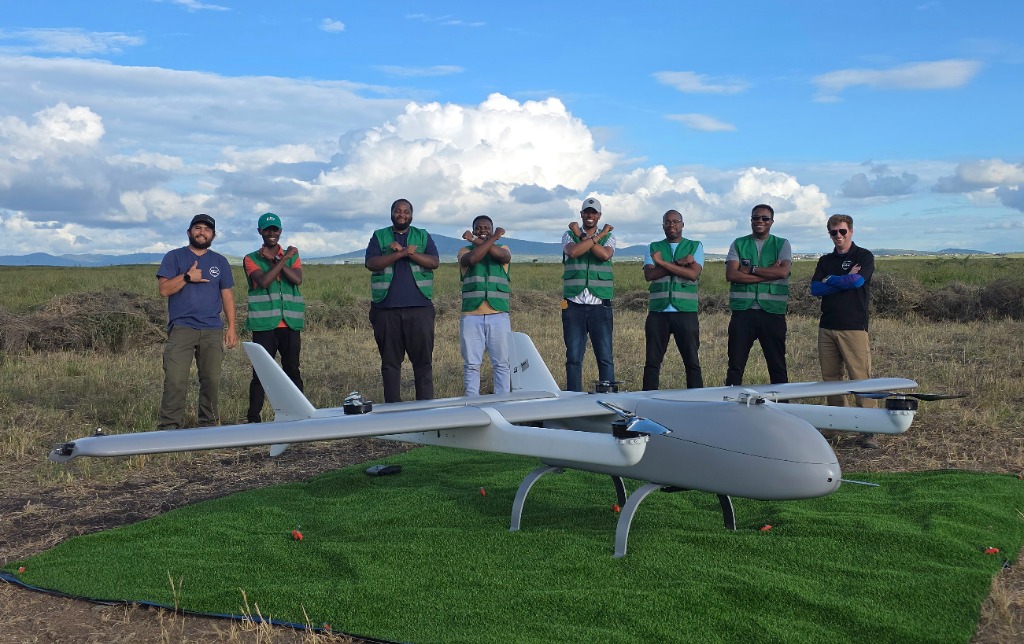
The team
Thatcher is run by a dedicated Kenyan team of flight operations, engineering, and logistics specialists working alongside civil aviation regulators, county health systems, and airframe engineers. The aircraft you see across this site is ours, registered in Kenya, and flown by this crew.
Talk to the teamNext step
Send us two points and a payload. We come back with transit time, sortie profile and what a live county network would look like.
Partners & Collaborators








Contact
Counties, health systems, funders and logistics operators — if you move time-sensitive cargo in Kenya, there is a route for it.